Introducing Forge: A Language Model Built for Multifamily
.avif)
Today I’m excited to introduce Forge, our post-trained model, purpose-built for multifamily real estate. Over the next few months, we’ll be rolling out Forge to Entrata customers as we continue to refine and improve its capability.
Forge is built around a simple idea: when a model already understands the industry it serves, it can get to the right answer faster, more precisely and more efficiently.
In our internal domain knowledge evaluation, Forge achieved the highest score of the models we tested while also delivering the lowest estimated token cost per task.
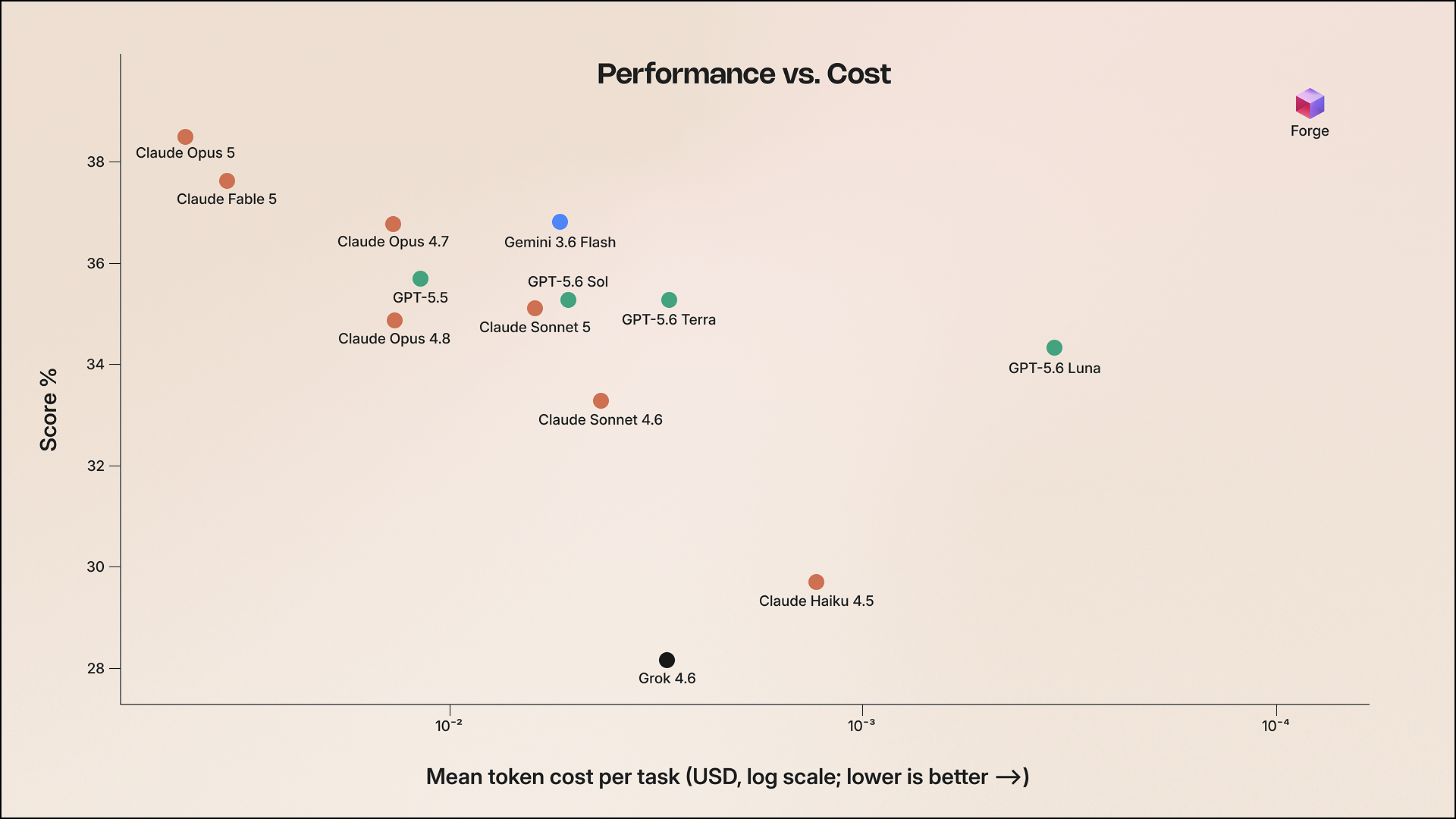
That doesn’t mean Forge is a better general purpose model than the frontier models being built by OpenAI, Anthropic, Google and others. Those models are extraordinary, and they remain an important part of Entrata’s AI architecture.
But the most capable general purpose model isn’t necessarily the best model for every job.
Forge is designed to do something much narrower exceptionally well: understand multifamily real estate, understand how multifamily work gets done, and understand how to find the right information inside the systems where that work happens.
That specialization can have a direct impact on performance, speed and economics. If a model already understands that a “turn” means preparing a vacated apartment for the next resident, it doesn’t need to spend time and tokens determining which of dozens of possible meanings the user intended. And when that same model understands the workflow behind the turn, the operator’s own rules for how it should happen, and where the relevant information lives, the path from question to answer gets dramatically shorter.
Less context to provide. Less unnecessary reasoning. Less data to retrieve. Faster responses and lower cost.
There are three layers to what we mean when we say Forge is purpose-built for multifamily.
1. Understand the industry
Consider a word as simple as “turn.” To a general purpose language model, turn can mean dozens of things: a change in direction, a sequence in a game, taking turns in conversation, turning something over.
In multifamily, the likely meaning is immediately obvious. A resident has moved out, and the unit needs to be inspected, repaired, cleaned and prepared for the next resident.
Forge begins with that context. Through post-training, domain understanding is encoded into the model itself. Rather than requiring users to repeatedly explain basic industry concepts, Forge can start closer to the actual problem.
The same applies to concepts like make ready, exposure, notice to vacate or concession. Forge has a prior on what these terms mean in the context of property management.
Forge starts the race several steps ahead.
2. Understand how the work gets done
Knowing what a turn means is only the beginning. A good property manager also understands how a turn should happen: what work happens first, which tasks depend on others, how long different stages should take and which delays require attention.
Every operator also does things a little differently. Entrata can provide Forge with governed context from a company’s SOPs and thousands of platform configurations that reflect how its business operates.
Imagine an operator expects units to be inspected within four hours of move-out, maintenance completed within 24 hours, cleaning within 12 hours after that, and anything outside those thresholds escalated. With that context, Forge isn’t merely recognizing terminology. It has a standard for what should happen, in what order, on what timeline, and according to whose rules.
If one operator expects a unit to be ready within 48 hours and another allows 72, the model shouldn’t apply a generic industry assumption. An operator’s SOPs, policies, terminology and operating expectations give Forge another layer of context, so it reasons according to how that organization actually runs.
That’s the difference between knowing the domain and knowing the business.
3. Understand where to look
An AI system can perfectly understand a question and still be inefficient if it doesn’t know how to find the answer.
Consider a regional manager asking: “Which units still aren’t ready from yesterday’s turns?”
Forge will understand not only what the question means, but which information is required to answer it: which units had move outs yesterday, which turns remain open, which make ready tasks have been completed, which are outstanding, and what is blocking the remaining units.
Because Forge is being built specifically to operate within the Entrata environment, it can increasingly understand how these concepts map to the underlying system. Combined with Entrata’s broader agent and tooling architecture, that means we can identify and retrieve the right information rather than sending enormous amounts of property data into a model and asking it to sort everything out.
The goal is a much more direct path: Understand the intent → apply the business context → identify the required data → retrieve what’s necessary → answer or act.
Now ask a more valuable question: “Which turns are falling behind and why?”
Forge understands what a turn is. It can apply the operator’s standards for how quickly each stage should happen. It can identify the operational data necessary to evaluate those standards, and the system can retrieve the relevant information and surface the exceptions—perhaps showing that three units are behind schedule, two are waiting on maintenance completion, and one missed the company’s cleaning SLA after maintenance was completed.
The operator didn’t have to specify which reports to run, which fields to inspect or how to join the information together. They simply asked the business question.
Forge understands the industry. It understands how the operator works. And it understands where to look.
That’s what purpose-built means to us.
The economics of knowing where to look
The economics of AI are often reduced to the price of a token. We think there’s another important question: How many tokens and how much computation does the model need to solve the problem in the first place?
Imagine two people trying to answer a question about a property. One knows nothing about property management. You first explain the terminology, then the workflow, then your company’s policies, then the structure of your software, and finally where the relevant information might be located.
The other has worked in your organization for years. You ask the question, and they immediately know what you mean and where to look.
The second person doesn’t necessarily have a bigger brain. They have context.
That’s the opportunity with Forge. A specialized model that begins with the right understanding can accomplish domain specific work with less context, fewer unnecessary reasoning steps and fewer tokens than a model that first has to establish all of that context. And when it knows what information actually matters, the system can retrieve more precisely instead of bringing unnecessary data into the model’s context window.
We think about this as intelligence per token: not simply what intelligence costs, but how efficiently that intelligence can get from intent to the right answer.
For a single conversation, those differences may seem small. Across AI agents operating continuously over thousands of properties and potentially millions of tasks, they compound quickly. A shorter path to the answer can mean lower latency, lower compute requirements and fundamentally better economics.
That’s what makes the early results in our domain knowledge evaluation so interesting. Specialization has the potential to change the cost performance for the work our customers actually need AI to perform.
Why this matters for agents
This becomes even more consequential as AI moves from answering questions to doing work.
Consider an operator asking: “Figure out why occupancy is falling at these five properties and tell me what we should do.”
Answering that well could involve leasing velocity, availability, exposure, notices, renewals, pricing, concessions, marketing performance and dozens of other signals. A frontier model can reason about each of those concepts. Forge begins with an understanding of how they relate in multifamily, while Entrata’s broader agent architecture can connect that understanding to the systems and tools needed to investigate and act.
That matters because agents won’t do this once. Over time, they will perform enormous numbers of tasks across a portfolio. Small advantages in context, precision, latency and cost compound quickly at that scale.
Domain expertise stops being nice to have. It becomes part of the infrastructure.
And agents are only one part of that picture. The same domain understanding can change how people query their data, analyze performance and interact with the operating system itself.
The right intelligence for the job
Forge doesn’t mean Entrata is moving away from frontier models. Quite the opposite. We believe the future AI stack will be heterogeneous.
Some problems will require the deepest reasoning capabilities of the world’s most advanced models. Others will benefit from specialized models that are faster, more efficient and deeply familiar with the domain. Many will require combinations of specialized and frontier models, retrieval, tools, deterministic software and agents.
Our job isn’t to choose one model and use it for everything. Our job is to orchestrate the right intelligence for the work being done.
Entrata has spent more than two decades building software around the workflows of this industry. We’ve learned its terminology, data relationships, operating patterns and countless conventions that people working in multifamily intuitively understand. In the AI era, that accumulated domain knowledge becomes incredibly valuable.
Forge is one part of how we’re putting that knowledge to work.
At Entrata Summit, we’ll share much more about what comes next: new ways to administer and govern AI across an organization, new ways for teams to securely interact with and query their data, and new AI-powered analytics designed to help operators move from information to action.
Together, these capabilities point toward where we believe property-management software is headed: AI that doesn’t simply sit beside the operating system, but is built into it and increasingly understands the business inside it.
The frontier AI labs will continue building models that know more about the world.
Our job is to make sure Entrata’s AI knows more about multifamily.
We’ll show you what that looks like at Summit.
A note on methodology
This post contains forward-looking statements regarding Entrata’s plans for the Forge model, including anticipated capabilities, deployment, and performance. These statements are based on current expectations and are subject to change. Actual results may differ.
The Forge results shown above reflect internal evaluations conducted in August 2026 of a medium-sized Forge model under our planned self-hosted deployment. Models evaluated included commercially available frontier models from major providers as of the evaluation date; the comparison set may not reflect subsequent model releases or updates.
Estimated Forge costs reflect Entrata’s internal infrastructure assumptions, including negotiated cloud-services pricing and high sustained utilization, and are not directly comparable to the publicly listed per-token pricing used for third-party models. Actual costs will vary.
The Domain Knowledge evaluation measures prior understanding of commonly used real estate terminology and Entrata customer language; it is not a measure of overall or general-purpose model intelligence. Responses were evaluated against required response criteria using multiple LLM judges. LLM-based evaluation is an emerging methodology with known limitations, including potential scoring biases, and results should not be interpreted as equivalent to independent third-party benchmarks. Because model generation and LLM-based evaluation contain stochastic variability, individual results differ between runs. Scores displayed represent averages across multiple evaluation runs.
These results are provided for informational purposes only and do not constitute a guarantee of future performance, cost savings, or functionality.
Interested in seeing what Entrata can do for you?
See how Entrata can transform your operations.